Back Labor and Sterile Water Injections… A Love Story
by Amy Nevland
It’s 2014, and the October air has a crispness to it, especially at 3am, as I head out of my car and up to my client’s door. It was her second baby, and though contractions had just only begun about an hour ago, they were already frequent and intense enough to cause her to breathe into the phone. I was her birth doula with her first baby, (a beautiful 9lb chubby girl) whom she birthed relatively quickly, comparatively, (about 6 hours total), and by all bystander’s accounts, she had made it look easy. Well. Easy enough. So, given that her last baby basically slid right out, I did not waste any time, and headed her way as soon as she called. I wasn’t sure if I’d even be able to offer any meaningful physical support at home before we would have to head to the hospital, but at least I could help them leave faster by helping dad pack up the car or help with childcare if they needed it until their mom arrived.
After triple checking I had indeed parked in front of the right house (my literal worst fear as a doula is to show up at the wrong house at 3am with massage lotion and a yoga ball), I gently knock on the door a few times, and text the dad that I was there. He, understandably disheveled, answers the door, and ushers me into a dimly let bedroom. He then mutters something about needing to load up the car, and, as he walks back into the living room, turns, and says, “Oh man, she says her back hurts a lot this time.” I try to offer a reassuring nod that gives off some semblance of confidence with a hint of empathy, but, man, I’ve got to tell you…sometimes at 3am, that combination is hard to project. So, instead, what comes out of my face is some sort of half-wink and a clicking noise from my mouth…the kind one makes to get a horse to move. I’m surprised I didn’t go all in and add finger guns, too. Lord. The dad just stares at me blankly and turns to leave. As I turn my attention to my client, she says, in a sort of panicked tone, “Oh Amy, I don’t know. My back is absolutely killing me this time. I don’t know if I can do it this time. I think I may need an epidural this time….and…If it just wasn’t for this back pain….” Now this is a far cry from the woman I remembered who rocked her first birth with hardly a peep. She was not able to get on top of her breath or get into the labor-zone this time around, at all. My doula brain kicks in. I say something about second babies coming faster and that we should leave now….and to just take them one at a time, but I bet you are closer than you think. But inside, I’m thinking about the dreaded “B” word. “Back Labor”. DUH-Duh-Dummmmm. My mental doula comfort measures rolodex starts spinning. Position change, rebozo, counter pressure and massage, hot and cold packs, Icy Hot, TENS Unit, hydrotherapy….
According to good ole’ WebMD, back labor can occur in 5% -8% of moms through the entirety of their labor. But according to this Cleveland Clinic article, 1 in 4 women experience intense back pain in labor. Buuuuut, according to this Science Direct article, in one small study, it was really more like 33% of women had continuous pain in their low back, vs 74% had intermittent low back pain that occurred with the contractions. While sometimes this is correlated with an OP baby (about 1 in 3), it’s not a given, so, I have her change positions a lot, just in case. I mean, we are doing all the Spinning-Babies things. In fact, while we are waiting for everything to be packed up, I get her into hands-and knees and child’s pose, I massage, I counter-press, and I squeeze…and she is having none.of.it. I break out my favorite tool….Hot Hands….those babies stay HOT for like 10 hours. They sort of help her, but are not her favorite, so I peel and stick the TENS unit pads to her lower back for the short ride to the hospital. TENS units have been shown to bring about a reduction in pain, and my client seemed to be needing all the help she could get.
Upon arrival at the hospital, we are promptly granted a labor room…pro tip: come in with a laboring mom who is moaning loud for all to here and say, “she’s a multip” to the check-in nurse. Once in the room, the nurses and I are try all the tricks to help her cope with each back-breaking contraction as she endures the gauntlet of routine hospital check-in procedures. “In the event of an emergency, do you consent to…blah blah blah..initial here, here and here. I need to draw three vials of blood and set a saline lock now, if you could just keep your arm still…”. As a certified doula, I had trained for this. Next thing to try: Penny’s “Take Charge Routine.” Next, some Lamaze breathing. I even feebly attempted a knee press and got yelled at. Man. I was feeling sad for this momma, wondering at the fact that her first birth could have been so seemingly easy when compared to this one, and wondering if we were going to end up getting an epidural, even though this client really had told me ahead of time she didn’t want one. At this moment, I am feeling totally out of my doula depths,…And then it happened. Time slowed. The room began to smell like lavender and patchouli, and in some distant closet or reverberous hospital shower, I swore I could hear angels singing AC/DC’s ‘Thunderstruck’ as my favorite midwife walked in. Oh Thank God! Over the years, I have seen her work miracles. What proverbial glittering rabbit was she going to pull out of her magic midwife hat today. Turns out, it was Sterile Water Injections.
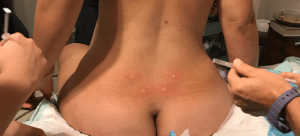
As the name might suggest, these are small, intradermal (just under the woman’s skin) or subcutaneous (usually .1 – 1mL) injections of 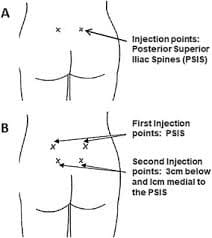 sterile water (not saline), in 2 to 4 areas strategically placed in diamond-like or rhombus shape on the women’s lower sacral area, where the mother is experiencing the most intense back pain. After the 4 points in the lumbosacral area are cleaned and maybe marked, the midwife and nurse each pick a side (to make the process go faster and get 2 injections done at one time) and simultaneously, during or after a contraction, inject the sterile water just under the surface of the first layer of skin, making a tiny bleb. The little blister or papule that forms at each site, will then slowly be broken down by the women’s body. This noxious stimulus, according to numerous studies dating all the way back to the 1980’s, seem to greatly reduce the intensity of pain in the area where the papules are made for up to 2 to 3 hours. The onset of pain relief is quick, too, usually within a few minutes and can be repeated up to three times once the affect wears off.
This simple and cheap pain reduction technique has been around for a long time. It’s first use was recorded in 1855 when W. Halsted wrote that “the skin can be completely anesthetized to any extent by cutaneous injections of water.” And a medical journal in 1904 stated that sterile water could be used as a local anesthetic during minor surgery. The more recent studies out there show benefits of pain reduction for patients with everything from whip lash to kidney stones (Martensson, 2008). Just recently, in fact, the NICE published an evidence review of sterile water injections in September of 2023. In it they say:
“…the majority of the evidence showed that sterile water injections had an important benefit in terms of general labour pain, back pain during labour and satisfaction…When compared to dry injections, sterile water injections at 0.4ml and 2ml doses showed an important benefit on general labour pains and back pains during labour. This was seen from 10 minutes up to 180 minutes,… “ (NICE 2023).
Sadly, even though this is a cheap, easy, and effective nonpharmacological tool for labor, I had never seen a provider up to that point ever offer it. I had even asked midwives and doctors for years, and all I got were blank stares, “why try that, when epidurals work better,” to blatant “no and those don’t work,” to the occasional tired curiosity. My experience, turns out, was echoed in this small study in 2008 by Martensson, et al. Basically, out of all the 132 midwives polled (via snail mail. Lol) about pain management options and uses in their practices, only about one fourth of those midwives/providers use SWI’s, albeit very infrequently. The other thing that was mentioned, was SWI’s cons. It actually does sting for about a minute or so at the time of the papule application, much like getting any sort of local anesthetic does, one might add. This is why it is sometimes administered during a contraction sometimes, as the contraction, itself acts as a distraction. The only other cons I could find were that for some moms they were ineffective. And, of course, because there is a puncture of sorts, there is always a risk of infection.
This midwife, who was helping my client this particular day, was the very same midwife who, four years earlier, had spent precious time educating a group of doulas, myself included, about the benefits of SWI (sterile water injections). This cool tool, however, had remained all theory, until the day of this birth story. Needless to say, I was all in, and so was my client, and so were the nurses, who really were jazzed about learning this new skill that they could easily and quickly administer to help their patients. ‘
Once all 4 papules or injections were made in my client’s lumbosacral area, literally within 2 to 3 minutes, she was remarking how now she could just focus on the relaxing with the contractions. Whereas before, the pain in her back was so acute, it made coping feel almost impossible to her, now she was swaying and breathing with a renewed sense of confidence. Luckily, 2 hours of relief was all she needed, as she quickly transitioned into pushing and delivery within the next hour or so. Then, just as quickly, she was up and going to the bathroom on her own. No epidural recovery needed, which would not have been the end of the world. But, for this mom and this labor experience, healthy mom and healthy baby were a given. She also wanted freedom of movement, and the least amount of medication possible. For her, looking back at this birth experience, she remarked it was exactly what she wanted (minus the back pain). She felt strong, empowered, heard, and supported. And sterile water injections were just the tool to make that happen.
Sources:
- American College of Obstetricians and Gynecologists. Committee Opinion No. 766: Approaches to limit intervention during labor and birth. 2019; https://www.acog.org/clinical/clinical-guidance/committee-opinion/articles/2019/02/approaches-to-limit-intervention-during-labor-and-birth.
- Caughey AB, et al. Nonpharmacologic approaches to management of labor pain. https://www.uptodate.com/contents/search. Accessed June 15, 2023.
- https://my.clevelandclinic.org/health/symptoms/21767-back-labor
- https://www.webmd.com/baby/what-is-back-labor
- https://www.sciencedirect.com/science/article/abs/pii/S0266613815001837#:~:text=Hence%2C%20when%20it%20(%20back%20pain%20),or%20indeed%2C%20from%20any%20other%20labour%2Drelated%20discomfort.
- Eur J Midwifery. 2024 Oct 18;8:10.18332/ejm/191511. doi: 10.18332/ejm/191511 https://pmc.ncbi.nlm.nih.gov/articles/PMC11487788/
- Sevil Günaydın, Ebru Şen, Tülay Yılmaz, Hüsniye Dinç Kaya, Use of Transcutaneous Electrical Nerve Stimulation (TENS) in Labor Pain: An Integrative Review, Pain Management Nursing, Volume 26, Issue 1, 2025, Pages 85-92, ISSN 1524-9042, https://doi.org/10.1016/j.pmn.2024.10.004. (https://www.sciencedirect.com/science/article/pii/S1524904224002698)
- Njogu A, Qin S, Chen Y, Hu L, Luo Y. The effects of transcutaneous electrical nerve stimulation during the first stage of labor: a randomized controlled trial. BMC Pregnancy Childbirth. 2021;21(1):164. Published 2021 Feb 24. doi:10.1186/s12884-021-03625-8 https://pmc.ncbi.nlm.nih.gov/articles/PMC7905652/
- Caesarean delivery rates and analgesia effectiveness following injections of sterile water for back pain in labour: A multicentre, randomised placebo controlled trial. Lee, Nigel et al. eClinicalMedicine, Volume 25, 100447. Aug. 2020. https://www.thelancet.com/journals/eclinm/article/PIIS2589-5370(20)30191-7/fulltext
- https://www.sarawickham.com/articles-2/sterile-water-injections/
- Intrapartum care [C] Evidence Reviews for Sterile Water Injections. NICE guideline NG235. Evidence reviews underpinning recommendations 1.6.13 to 1.6.15 in the NICE guideline. September 2023. https://www.nice.org.uk/guidance/ng235/evidence/c-sterile-water-injections-pdf-13186672960
- Mårtensson L, McSwiggin M, Mercer JS. US midwives’ knowledge and use of sterile water injections for labor pain. J Midwifery Womens Health. 2008 Mar-Apr;53(2):115-22. doi: 10.1016/j.jmwh.2007.09.008. PMID: 18308260. https://pubmed.ncbi.nlm.nih.gov/18308260/